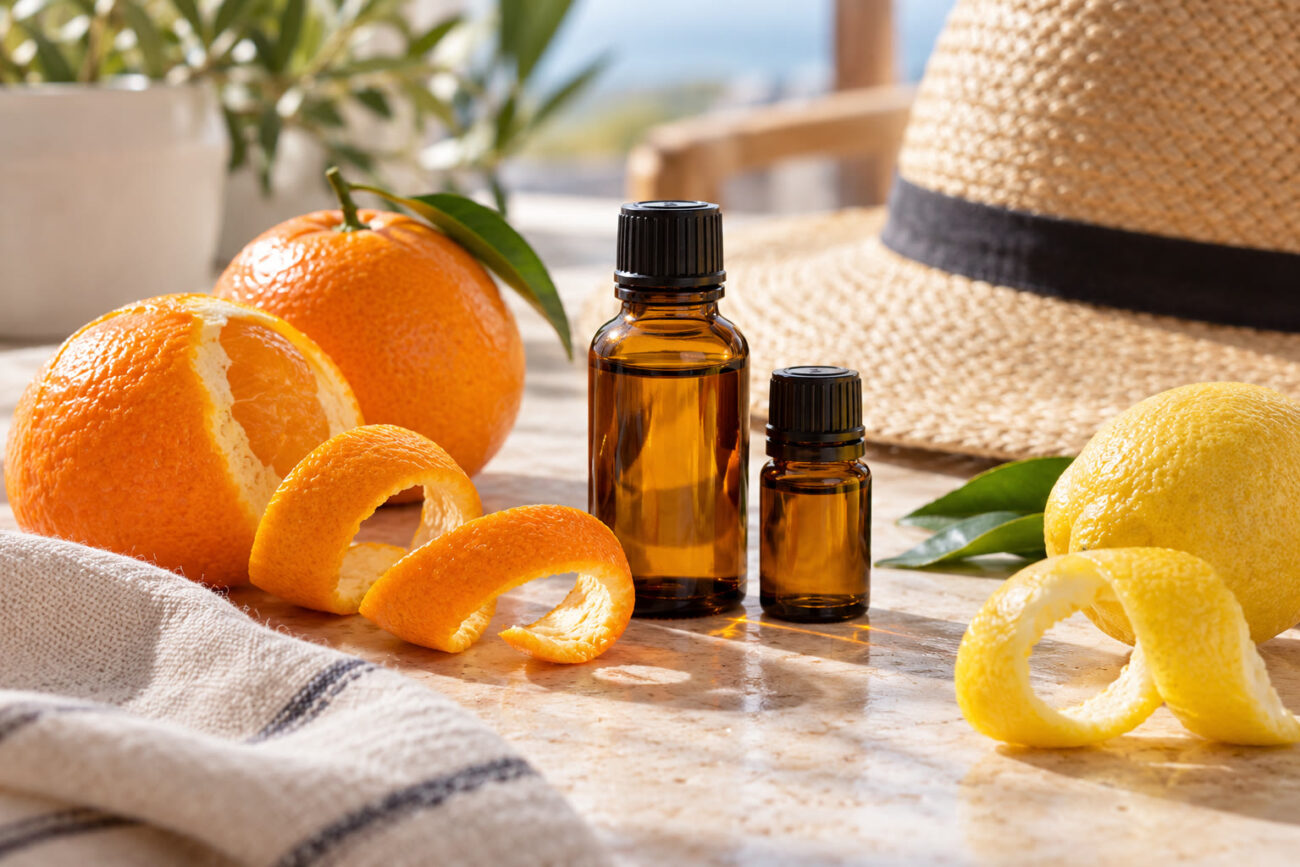
You’re looking for clear advice on citrus essential oils and sun exposure, and strong claims can make a simple choice feel complicated. That confusion can lead to unnecessary exposure, wasted money, or expectations a product can’t meet. The useful question is how the scent is used, who may be affected, and what the evidence can support. This guide shows you how to check those details and choose a cautious next step.
Look for the botanical name
“Citrus oil” isn’t one ingredient. Bergamot, lemon, lime, grapefruit, and other citrus oils can differ in composition and phototoxicity risk. Labels that give the botanical name and plant part are easier to evaluate than vague fruit-scented descriptions.
Phototoxicity is a skin reaction
Certain furanocoumarins can increase susceptibility to sunburn or a reaction after ultraviolet exposure. The effect depends on the material and its dose, not simply on whether it’s called natural. A wash-off soap and a leave-on topical product can also create different exposure.
Patch testing doesn’t predict sun sensitivity
A small skin test may help identify immediate irritation, but it can’t prove that a product is safe in sunlight. Follow product warnings, avoid homemade citrus blends before outdoor exposure, and use ordinary sun protection when the skin will be exposed.
Choose the least complicated scent option
If you want a citrus-like scent without uncertain skin exposure, choose a fragrance product explicitly evaluated for its intended use. Keep essential-oil bottles away from children, avoid drinking them, and ask a pharmacist or dermatologist about a specific topical product when needed.
What should this guide help you decide?
A useful understanding of the safety question should survive contact with a real setting, a busy day, or a situation that doesn’t match the example. For the safety question, that objective is deliberately practical: it asks for reasoning rather than memorization and leaves room for context to matter.
The lesson belongs to the Essential Oils & Aromatherapy desk, where the central question is the relationship among botanical identity, concentration, route, duration, and personal tolerance. With the safety question, start with the purpose of the decision, then distinguish what is directly observable from what you’re inferring. For the safety question, that discipline matters because a familiar scent or a plant origin doesn’t establish medical effectiveness or universal safety.
How can you tell this approach is working?
You have understood the safety question when you can name the outcome you want, point to the information that supports the next step, and state what you would do if the evidence or your experience contradicted the expectation. That three-part answer is more reliable than repeating a slogan.
How can you interpret the choice?
A reliable method for examining the safety question is to construct a concise argument instead of accumulating disconnected tips. To make that argument about the safety question, first name the desired result. Next, test the available evidence against that result. Finally, ask whether the practical constraints make the answer workable. The checkpoints for this particular lesson are look for the botanical name, phototoxicity is a skin reaction, patch testing doesn’t predict sun sensitivity.
The central concept in the safety question is the relationship among botanical identity, concentration, route, duration, and personal tolerance. For the safety question, that framing matters because it prevents a single feature from carrying more meaning than it can bear. You may notice the botanical name, the stated route of use, and the response during a brief exposure when considering the safety question, but each observation supports a different kind of conclusion. Your analytical task with the safety question is to keep those conclusions proportional to the evidence rather than letting a vivid detail dominate the whole judgment.
With a labeled essential-oil product and its intended route of exposure, separate the information supplied by the maker from the conclusion you would need to test in ordinary use.
Which questions keep the comparison fair?
- What is the intended outcome, and who or what could be affected?
- Which claim is supported by the information available?
- What practical limitation would change the recommendation?
For the safety question, write the answers in full sentences rather than relying on a feeling of confidence. For the safety question, the exercise slows the decision just enough to reveal assumptions, and it gives you a record you can revisit after testing the choice in ordinary conditions.
Before leaving this lesson on the safety question, return to the decision once more with a calm, practical standard. For this question, notice what you now understand, what remains uncertain, and which small observation would make the next step about the safety question more defensible. The caring choice regarding the safety question is to act provisionally, review honestly, and leave room for what ordinary experience reveals.
What final check can sharpen your decision?
A rigorous lesson about the safety question must keep concentration, route, duration, and population visible at the same time, because a conclusion that’s reasonable for a brief, diluted application can’t be transferred automatically to inhalation in a shared room or to an undiluted cosmetic use. The relevant exposure is produced by the whole situation rather than by the botanical name alone, and this is why instructions and warnings belong to the evidence rather than to an administrative footnote. When those variables are separated, it becomes possible to make a more modest claim about what can be tried safely and what requires qualified advice. That discipline protects both the pleasure of scent and the trust of the person using it.
Fresh scent, different safety profile
Citrus oils aren’t interchangeable, and sun exposure turns some pleasant uses into avoidable risks. Know the oil, follow the product’s warning, and don’t guess at safe sun use.
How can you put this into practice?
What should you check before using a scent?
Pick one product you’re considering and start with its label rather than a broad claim about the ingredient. Write down where the maker says to use it, how it should be applied, and who else may share the space. Keep the trial small enough that you can stop easily if the scent feels uncomfortable. Note the room and duration so you can make a fair decision about whether the routine suits you.
- Check the product’s intended use.
- Note the directions and stated precautions.
- Choose a clear stop point before you begin.
These companion guides cover related decisions: Lavender Oil: What People Use It For and Tea Tree Oil: Common Uses and Limitations. Browse the Essential Oils & Aromatherapy desk for the wider cluster.
Background source: National Center for Complementary and Integrative Health: Aromatherapy.
Take 10 minutes to read one scent product’s label and note its intended use and one precaution. What will you check before using it?
