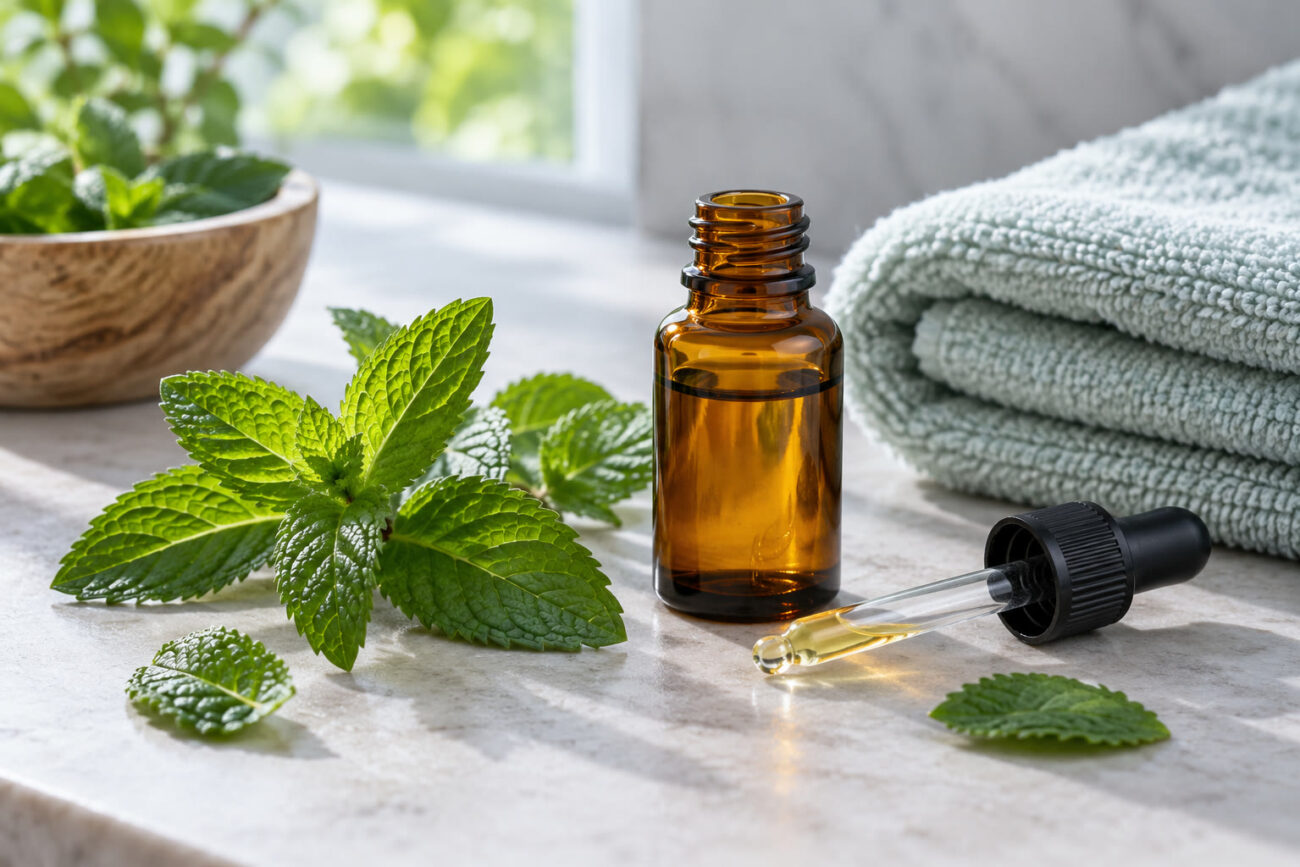
You’re looking for clear advice on peppermint oil and skin, and strong claims can make a simple choice feel complicated. That confusion can lead to unnecessary exposure, wasted money, or expectations a product can’t meet. The useful question is how the scent is used, who may be affected, and what the evidence can support. This guide shows you how to check those details and choose a cautious next step.
The cooling effect can be misleading
Menthol changes how skin feels without necessarily making pain or inflammation better. A strong tingle may be pleasant for one person and painful for another. More oil doesn’t create a more careful treatment, especially on large areas or damaged skin.
Keep it away from sensitive areas
Peppermint oil shouldn’t be applied to the eyes, eyelids, nostrils, mucous membranes, broken skin, or other particularly sensitive areas. Wash hands after handling it, and avoid touching the face before the oil has been removed. Spills should be cleaned up promptly.
Dilution and product directions matter
A product intended for topical use should explain its own dilution and restrictions. don’t assume that a comfortable amount on the wrist will be comfortable on the chest, abdomen, or a child. Children and people with relevant medical conditions need individual advice.
Stop at irritation, not at tolerance
Remove the product and wash the area if it burns, stings, or turns red. Seek help if symptoms are severe or spreading. A persistent reaction isn’t a reason to repeat exposure until the skin adapts.
What should this guide help you decide?
A useful understanding of the product-use question should survive contact with a real setting, a busy day, or a situation that doesn’t match the example. The test is whether you can make a more defensible choice about the product-use question afterward and explain why an alternative might also be reasonable for someone else.
The lesson belongs to the Essential Oils & Aromatherapy desk, where the central question is the relationship among botanical identity, concentration, route, duration, and personal tolerance. With the product-use question, start with the purpose of the decision, then distinguish what is directly observable from what you’re inferring. For the product-use question, that discipline matters because a familiar scent or a plant origin doesn’t establish medical effectiveness or universal safety.
Care, caution, and the next responsible step
Safety is part of the method, not a disclaimer added after learning. For the product-use question, begin with the least exposure that can answer your question, follow current directions, and keep other variables steady. A modest trial produces clearer information than an aggressive experiment, and it leaves more room to respond if the result is unexpected.
- Read the complete product directions and keep the original packaging.
- Stop and remove the product if persistent pain, irritation, breathing difficulty, or another concerning symptom appears.
- Seek qualified medical or poison-control help when the situation exceeds ordinary self-care.
A caring lesson about the product-use question doesn’t make you afraid of ordinary choices. It teaches you to notice when the question has moved beyond product preference and into health or safety, then to choose appropriate help without treating that boundary as a personal failure.
How to reason through the details
Think about the product-use question as a sequence of connected judgments rather than a collection of slogans. For the product-use question, define what the choice must accomplish, inspect the information that bears on that purpose, and then assess whether everyday conditions permit the recommendation. The checkpoints for this particular lesson are the cooling effect can be misleading, keep it away from sensitive areas, dilution and product directions matter.
The central concept in the product-use question is the relationship among botanical identity, concentration, route, duration, and personal tolerance. For the product-use question, that framing matters because it prevents a single feature from carrying more meaning than it can bear. You may notice the botanical name, the stated route of use, and the response during a brief exposure when considering the product-use question, but each observation supports a different kind of conclusion. Your analytical task with the product-use question is to keep those conclusions proportional to the evidence rather than letting a vivid detail dominate the whole judgment.
In the classroom, work with a labeled essential-oil product and its intended route of exposure for the product-use question. Ask what the comparison is meant to establish before asking which option sounds more appealing.
Before leaving this lesson on the product-use question, return to the decision once more with a calm, practical standard. For this question, notice what you now understand, what remains uncertain, and which small observation would make the next step about the product-use question more defensible. The caring choice regarding the product-use question is to act provisionally, review honestly, and leave room for what ordinary experience reveals.
How do the details fit together?
A rigorous lesson about the product-use question must keep concentration, route, duration, and population visible at the same time, because a conclusion that’s reasonable for a brief, diluted application can’t be transferred automatically to inhalation in a shared room or to an undiluted cosmetic use. The relevant exposure is produced by the whole situation rather than by the botanical name alone, and this is why instructions and warnings belong to the evidence rather than to an administrative footnote. When those variables are separated, it becomes possible to make a more modest claim about what can be tried safely and what requires qualified advice. That discipline protects both the pleasure of scent and the trust of the person using it.
What principle guides this choice?
The phrase “essential oil” groups chemically diverse materials, so evidence about lavender can’t be used as automatic evidence for peppermint, citrus, or tea tree simply because all four appear in the aromatherapy aisle. A meaningful interpretation asks which species, plant part, concentration, delivery method, and outcome were studied, then compares those conditions with the product actually at hand. If the comparison fails, the honest response is to treat the claim as suggestive at best and to rely on the product directions rather than an extrapolated therapeutic promise. This standard is demanding, but it gives scent guidance the intellectual honesty expected of university-level material.
A caring safety framework for the product-use question shouldn’t confuse a natural origin with proportionality. Plant-derived materials can be potent, allergenic, or hazardous when misused, while the amount and route of exposure often matter more than the romantic story attached to the bottle. The practical task is therefore to minimize unnecessary exposure while preserving the intended experience: use less, ventilate a room, avoid delicate areas, and establish a stopping point before the trial begins. Such precautions don’t diminish the value of a pleasant ritual. They make that ritual compatible with the vulnerability of other people, pets, and the person applying the product.
it’s useful to distinguish a supportive sensory experience from a tested medical treatment when evaluating the product-use question. A familiar fragrance may cue a pause or a bedtime routine through expectation and association, but the strength of that personal meaning doesn’t establish efficacy for a diagnosed condition. Conversely, the absence of a proven treatment effect doesn’t make a modest, safe ritual meaningless. It simply changes the claim that can be supported. Maintaining that distinction prevents both unwarranted therapeutic promises and the opposite error of dismissing every experiential benefit as irrelevant.
Strong sensation isn’t proof of benefit
Treat peppermint oil as a concentrated aromatic ingredient with clear limits. Keep exposure small, avoid delicate areas, and stop when the skin gives an uncomfortable signal.
Related practical guidance includes Lavender Oil: What People Use It For and Tea Tree Oil: Common Uses and Limitations. Browse the Essential Oils & Aromatherapy desk for the wider cluster.
For more situations when avoiding topical essential oils makes sense, see When to Skip Essential Oils on Skin.
Further reading: National Center for Complementary and Integrative Health: Aromatherapy.
Take 10 minutes to read one scent product’s label and note its intended use and one precaution. What will you check before using it?
