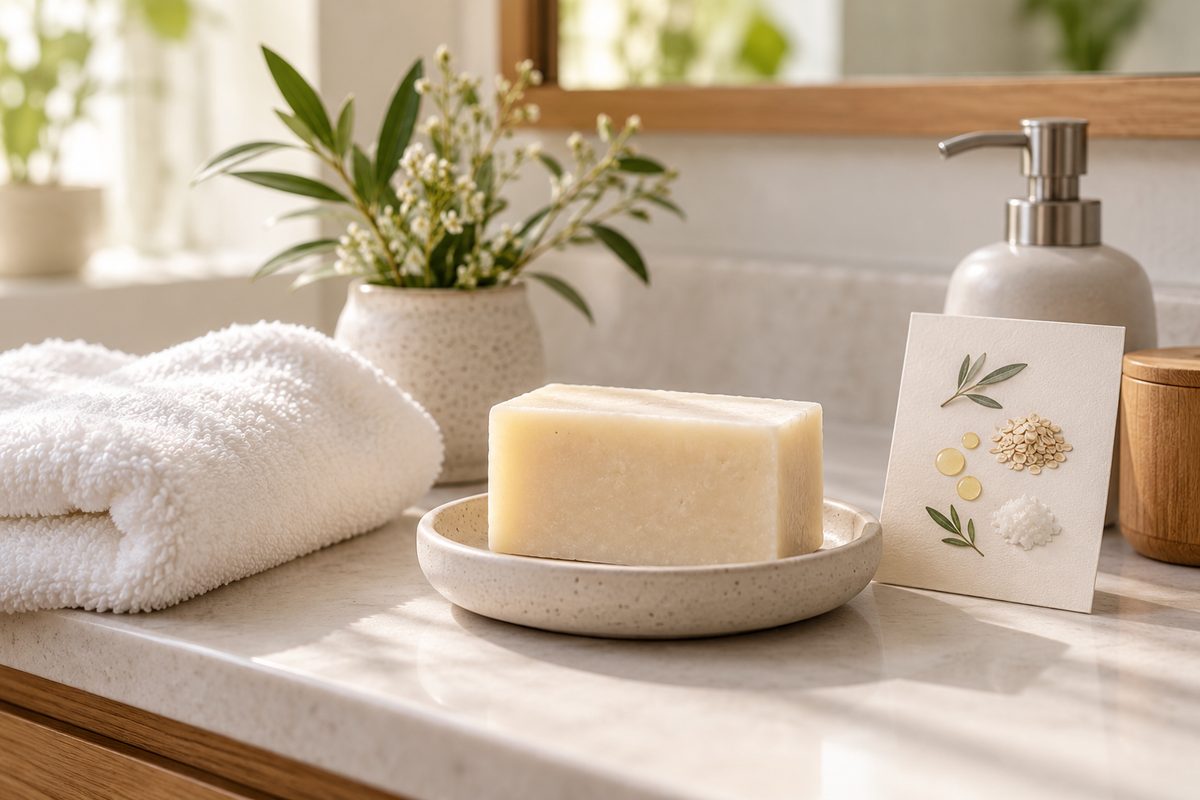
You’re looking for clear advice on how to choose organic soap for sensitive skin, and mixed guidance can make it hard to tell what fits your skin. That uncertainty can cost you time and money while leaving you unsure what to change. The decision depends on the product details, how you use it, and how your skin responds. This guide shows you what to check, how to make one careful change, and when to seek more help.
Begin with the reaction you’re trying to avoid
Name the experience that prompted the search: tightness after washing, itching, redness, persistent dryness, or a reaction to a known scent. Different problems point toward different questions. A product associated with persistent rashes isn’t automatically the solution merely because its front label says gentle. A qualified professional may need to assess recurring or severe symptoms.
- Separate observable events from assumptions about the cause.
- Record the product, the area used, and the timing of the response.
- Avoid introducing a scrub or second new product during the same trial.
Read “natural” as a starting clue
Plant oils, essential oils, botanicals, clays, and fragrances can all be relevant to sensitive skin. Natural origin says something about how a material is sourced or described, not whether an individual will tolerate it. A short formula can be easier to review, but simplicity is only an aid to tracking. It isn’t proof of safety or mildness.
- Check the complete ingredient list when it’s available.
- Look specifically for fragrance materials and known sensitivities.
- Patch test according to the product’s instructions before broader use.
Introduce the bar with one controlled change
Use the soap in the way you normally would, on a limited basis at first, while keeping temperature, laundry products, moisturizer, and other variables steady. A short, ordinary trial is more informative than an elaborate experiment. If a reaction appears, stop the newest product and let the skin settle before deciding what to investigate next.
- Keep contact time and water temperature comfortable.
- don’t scrub or leave soap on longer than directed.
- Seek medical advice for swelling, severe pain, widespread rash, or breathing difficulty.
Know when soap is no longer the right question
Some skin problems persist despite careful product choices because the cause isn’t a single cleanser. Persistent inflammation, cracking, infection concerns, or repeated reactions deserve assessment. The goal of this lesson isn’t to make you afraid of soap, but to help you recognize when a controlled trial has reached its limit and professional care becomes the more responsible next step.
- Bring the product packaging or ingredient list to a clinical appointment.
- Describe when the problem started and what changed.
- don’t use a stronger product to compensate for irritation.
What should you be able to explain?
A useful understanding of the ingredient question should survive contact with a real setting, a busy day, or a situation that doesn’t match the example. Because the ingredient question is a matter of judgment, the goal is transferable understanding rather than a list of rules to repeat.
The lesson belongs to the Organic Soap & Ingredients desk, where the central question is the relationship among ingredient identity, formula balance, and the finished bar. With the ingredient question, start with the purpose of the decision, then distinguish what is directly observable from what you’re inferring. For the ingredient question, that discipline matters because a label can disclose composition and directions, but it can’t prove that one formula will suit every person.
What standard should you apply?
You have understood the ingredient question when you can name the outcome you want, point to the information that supports the next step, and state what you would do if the evidence or your experience contradicted the expectation. That three-part answer is more reliable than repeating a slogan.
How can you make a decision you can explain?
A strong analysis of the ingredient question asks what the choice is for, which evidence is genuinely relevant, and whether the resulting recommendation survives ordinary use. The checkpoints for this particular lesson are begin with the reaction you’re trying to avoid, read “natural” as a starting clue, introduce the bar with one controlled change.
The central concept in the ingredient question is the relationship among ingredient identity, formula balance, and the finished bar. For the ingredient question, that framing matters because it prevents a single feature from carrying more meaning than it can bear. You may notice the ingredient sequence, the role of the featured oil, and how the bar behaves when stored when considering the ingredient question, but each observation supports a different kind of conclusion. Your analytical task with the ingredient question is to keep those conclusions proportional to the evidence rather than letting a vivid detail dominate the whole judgment.
Picture two products with comparable intended uses in relation to the ingredient question. The useful comparison begins with intended use, because a feature that matters in one setting may be irrelevant in another.
What final check can sharpen your decision?
A defensible interpretation of the ingredient question distinguishes declared composition from inferred performance, because an ingredient panel can describe what a maker represents as present without establishing how the finished product will behave under the particular conditions created by water, contact time, storage, and individual skin tolerance. This distinction becomes consequential when a featured botanical or oil is used rhetorically to imply that the entire formula is gentle, conditioning, or environmentally preferable. The analytical question is therefore not whether one ingredient has an appealing reputation, but whether the remaining evidence justifies the recommendation for this intended use. When those conditions diverge, the responsible conclusion is a narrower, conditional judgment that names the uncertainty and identifies the practical observation capable of resolving it.
Why the distinction matters
A second conceptual safeguard is to resist ingredient essentialism: the assumption that the ingredient with the most recognizable name necessarily determines the experience of the finished bar. Formulation is a system of relationships among cleansing components, conditioning materials, fragrance, processing, and use, so the same featured oil can participate in products with substantially different physical and sensory profiles. By examining those relationships, you can explain why two bars that both advertise organic ingredients may warrant different expectations without assigning one ingredient an implausible power over the whole product. That form of explanation is more rigorous than ranking products according to a single fashionable word.
Related practical guidance includes Why Short Ingredient Lists Can Help with Product Tracking and Olive Oil Soap: What Makes It Different?. Browse the Organic Soap & Ingredients desk for the wider cluster.
Reference: USDA Agricultural Marketing Service: Organic Standards.
In the next 10 minutes, write down one skin-care change you can make while keeping the rest of your routine steady. Which detail will you watch first?
