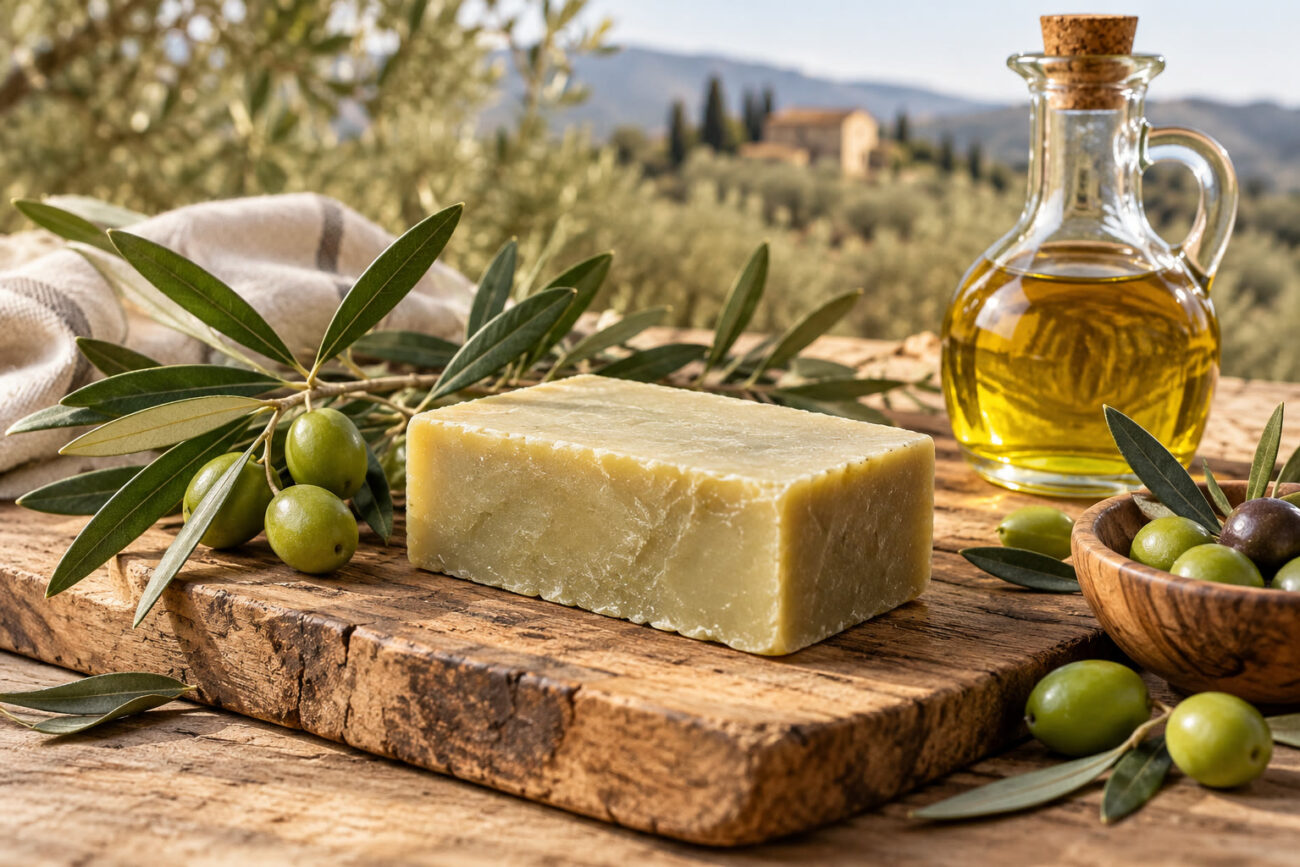
You’re looking for clear advice on olive oil soap, and a single label or ingredient can make the answer seem simpler than it’s. That can waste money or leave you unsure whether a product fits its intended use. The better approach is to compare the whole formula, directions, and practical tradeoffs. This guide shows you what to look for and how to assess the choice in your own routine.
Why olive-oil soap feels creamy
Olive oil is rich in oleic acid and tends to produce a dense, creamy lather rather than a large volume of bubbles. In a well-balanced recipe, that can feel smooth and comfortable. In a bar with very high olive oil content, the lather may be quieter and the bar may soften more readily when left wet.
- Expect a creamy rather than dramatic lather.
- Look for a draining soap dish or another storage method that keeps the bar dry.
- Judge the whole formula rather than assuming olive oil is the only ingredient that matters.
The tradeoffs hidden by “olive oil”
A high olive-oil percentage doesn’t make every bar mild or moisturizing. Cleansing strength depends on the complete set of oils and the amount of superfat, while fragrance, essential oils, exfoliants, and the bar’s pH can also affect comfort. “Olive oil soap” describes the formula’s direction, not a guarantee about your skin.
- Check whether the label lists olive oil first or merely mentions it in marketing copy.
- Ask about cure time if you buy from a small maker.
- Patch test if the bar contains an ingredient you haven’t used before.
How to judge a bar in real use
Start by using the bar for ordinary washing and notice whether it stays firm, rinses cleanly, and feels comfortable after drying. A creamy lather that leaves the skin tight isn’t an upgrade over a modest lather that feels better. Storage can change the experience too: a bar that sits in water may become soft even when the recipe is sound.
- Use one bar at a time so its performance is easier to assess.
- Keep the bar dry between uses.
- Consider a smaller bar if you want to test the formula before committing to a large one.
What should you be able to explain?
The aim of this guide isn’t to hand you a verdict about the formula comparison, but to make the reasoning behind a sound choice visible. Because the formula comparison is a matter of judgment, the goal is transferable understanding rather than a list of rules to repeat.
The lesson belongs to the Organic Soap & Ingredients desk, where the central question is the relationship among ingredient identity, formula balance, and the finished bar. With the formula comparison, start with the purpose of the decision, then distinguish what is directly observable from what you’re inferring. For the formula comparison, that discipline matters because a label can disclose composition and directions, but it can’t prove that one formula will suit every person.
What standard should you apply?
You have understood the formula comparison when you can name the outcome you want, point to the information that supports the next step, and state what you would do if the evidence or your experience contradicted the expectation. That three-part answer is more reliable than repeating a slogan.
Move from a general claim to a defensible judgment
A strong analysis of the formula comparison asks what the choice is for, which evidence is genuinely relevant, and whether the resulting recommendation survives ordinary use. The checkpoints for this particular lesson are why olive-oil soap feels creamy, the tradeoffs hidden by “olive oil”, how to judge a bar in real use.
The central concept in the formula comparison is the relationship among ingredient identity, formula balance, and the finished bar. For the formula comparison, that framing matters because it prevents a single feature from carrying more meaning than it can bear. You may notice the ingredient sequence, the role of the featured oil, and how the bar behaves when stored when considering the formula comparison, but each observation supports a different kind of conclusion. Your analytical task with the formula comparison is to keep those conclusions proportional to the evidence rather than letting a vivid detail dominate the whole judgment.
In the classroom, work with two products with comparable intended uses for the formula comparison. Ask what the comparison is meant to establish before asking which option sounds more appealing.
Before leaving this lesson on the formula comparison, return to the decision once more with a calm, practical standard. For this question, notice what you now understand, what remains uncertain, and which small observation would make the next step about the formula comparison more defensible. The caring choice regarding the formula comparison is to act provisionally, review honestly, and leave room for what ordinary experience reveals.
Why the distinction matters
A defensible interpretation of the formula comparison distinguishes declared composition from inferred performance, because an ingredient panel can describe what a maker represents as present without establishing how the finished product will behave under the particular conditions created by water, contact time, storage, and individual skin tolerance. This distinction becomes consequential when a featured botanical or oil is used rhetorically to imply that the entire formula is gentle, conditioning, or environmentally preferable. The analytical question is therefore not whether one ingredient has an appealing reputation, but whether the remaining evidence justifies the recommendation for this intended use. When those conditions diverge, the responsible conclusion is a narrower, conditional judgment that names the uncertainty and identifies the practical observation capable of resolving it.
Why the distinction matters
A second conceptual safeguard is to resist ingredient essentialism: the assumption that the ingredient with the most recognizable name necessarily determines the experience of the finished bar. Formulation is a system of relationships among cleansing components, conditioning materials, fragrance, processing, and use, so the same featured oil can participate in products with substantially different physical and sensory profiles. By examining those relationships, you can explain why two bars that both advertise organic ingredients may warrant different expectations without assigning one ingredient an implausible power over the whole product. That form of explanation is more rigorous than ranking products according to a single fashionable word.
The evidence hierarchy for the formula comparison should remain proportionate to the claim being made. A manufacturer can document a certification, identify a botanical species, or disclose an ingredient list with considerable precision while still lacking product-specific evidence about long-term comfort for a particular person. Consequently, a well-reasoned recommendation combines documentary evidence with explicit boundaries: what the label establishes, what the directions imply, and what can only be learned through a cautious trial. This layered conclusion is slower to state than a universal verdict, but it’s more faithful to the uncertainty that surrounds personal-care choices and less likely to encourage unnecessary purchases or repeated irritation.
A creamy bar, not a universal recommendation
Olive-oil soap is worth trying when you want a dense, low-foam texture and are prepared to store the bar carefully. Let the complete formula and your own response decide whether it belongs in your routine.
For more practical context, explore How to Choose Organic Soap for Sensitive Skin and Oatmeal Soap for Dry Skin: What to Know. Browse the Organic Soap & Ingredients desk for the wider cluster.
Reference: USDA Agricultural Marketing Service: Organic Standards.
Take 10 minutes to inspect one soap label and note a detail you want to compare before buying again. Which detail will you check first?
