You’re looking for clear advice on calendula in soap, and a single label or ingredient can make the answer seem simpler than it’s. That can waste money or leave you unsure whether a product fits its intended use. The better approach is to compare the whole formula, directions, and practical tradeoffs. This guide shows you what to look for and how to assess the choice in your own routine.
How calendula changes the look and feel
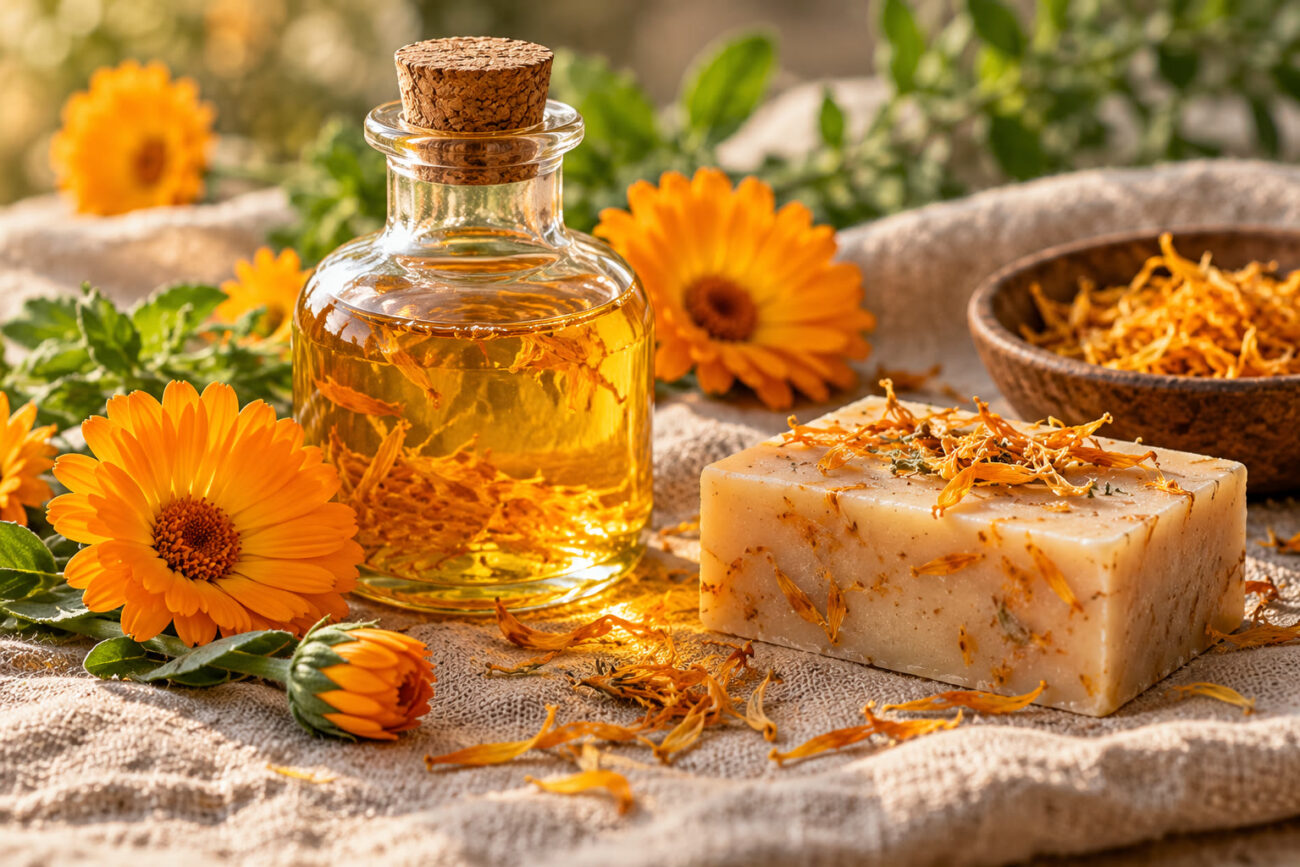
Petals may stay visible as speckles or turn brown during curing, while an infused oil can add a warm color without visible plant matter. Coarse petals can feel textured against the skin, and the scent of the flower is usually too faint to survive the soapmaking process. These are cosmetic differences before they’re therapeutic ones.
- Look for infused oil or finely ground petals if texture is a concern.
- Expect natural colors to change over time.
- don’t assume a stronger floral scent means more calendula.
The limits of a rinse-off botanical
Calendula is commonly associated with soothing traditions, but soap is washed away quickly and may contain fragrance oils, essential oils, or other botanicals that complicate the experience. A pleasant association doesn’t establish that the bar will relieve a rash or replace medical treatment.
- Patch test a new bar, especially if you have reacted to plants before.
- Check the full fragrance and preservative information when available.
- Seek medical advice for persistent or severe skin symptoms.
Use the flower as one clue among several
A well-made calendula bar can be creamy, visually appealing, and pleasant to use. Judge it by the cleansing base, storage behavior, scent, and texture, then give it a modest trial. Small-batch labels and maker answers can tell you more than a generic calendula claim.
- Ask whether the petals are decorative or infused into an oil.
- Keep the bar dry between uses.
- Treat irritation as a reason to stop, not a reason to use more product.
What should you be able to explain?
Read this article as a short lesson in judgment: the ingredient question becomes easier when its purpose, evidence, and limits are separated. The test is whether you can make a more defensible choice about the ingredient question afterward and explain why an alternative might also be reasonable for someone else.
The lesson belongs to the Organic Soap & Ingredients desk, where the central question is the relationship among ingredient identity, formula balance, and the finished bar. With the ingredient question, start with the purpose of the decision, then distinguish what is directly observable from what you’re inferring. For the ingredient question, that discipline matters because a label can disclose composition and directions, but it can’t prove that one formula will suit every person.
What standard should you apply?
You have understood the ingredient question when you can name the outcome you want, point to the information that supports the next step, and state what you would do if the evidence or your experience contradicted the expectation. That three-part answer is more reliable than repeating a slogan.
How can you make a decision you can explain?
A strong analysis of the ingredient question asks what the choice is for, which evidence is genuinely relevant, and whether the resulting recommendation survives ordinary use. The checkpoints for this particular lesson are how calendula changes the look and feel, the limits of a rinse-off botanical, use the flower as one clue among several.
The central concept in the ingredient question is the relationship among ingredient identity, formula balance, and the finished bar. For the ingredient question, that framing matters because it prevents a single feature from carrying more meaning than it can bear. You may notice the ingredient sequence, the role of the featured oil, and how the bar behaves when stored when considering the ingredient question, but each observation supports a different kind of conclusion. Your analytical task with the ingredient question is to keep those conclusions proportional to the evidence rather than letting a vivid detail dominate the whole judgment.
Picture two products with comparable intended uses in relation to the ingredient question. The useful comparison begins with intended use, because a feature that matters in one setting may be irrelevant in another.
Before leaving this lesson on the ingredient question, return to the decision once more with a calm, practical standard. For this question, notice what you now understand, what remains uncertain, and which small observation would make the next step about the ingredient question more defensible. For the ingredient question, you can pause without treating uncertainty as failure, and you can return when a better observation becomes available.
What final check can sharpen your decision?
A defensible interpretation of the ingredient question distinguishes declared composition from inferred performance, because an ingredient panel can describe what a maker represents as present without establishing how the finished product will behave under the particular conditions created by water, contact time, storage, and individual skin tolerance. This distinction becomes consequential when a featured botanical or oil is used rhetorically to imply that the entire formula is gentle, conditioning, or environmentally preferable. The analytical question is therefore not whether one ingredient has an appealing reputation, but whether the remaining evidence justifies the recommendation for this intended use. When those conditions diverge, the responsible conclusion is a narrower, conditional judgment that names the uncertainty and identifies the practical observation capable of resolving it.
How do the details fit together?
A second conceptual safeguard is to resist ingredient essentialism: the assumption that the ingredient with the most recognizable name necessarily determines the experience of the finished bar. Formulation is a system of relationships among cleansing components, conditioning materials, fragrance, processing, and use, so the same featured oil can participate in products with substantially different physical and sensory profiles. By examining those relationships, you can explain why two bars that both advertise organic ingredients may warrant different expectations without assigning one ingredient an implausible power over the whole product. That form of explanation is more rigorous than ranking products according to a single fashionable word.
Tradition is useful when the details are clear
Calendula adds character and a recognizable tradition to soap, but neither feature guarantees comfort. Choose a formula that explains how the botanical was used and test it as one part of a gentle routine.
For an adjacent question, see Coconut Oil in Soap: Benefits and Tradeoffs and Shea Butter Soap: A Practical Guide. Browse the Organic Soap & Ingredients desk for the wider cluster.
Background source: USDA Agricultural Marketing Service: Organic Standards.
Take 10 minutes to inspect one soap label and note a detail you want to compare before buying again. Which detail will you check first?
