You’re looking for clear advice on how to store essential oils properly, and strong claims can make a simple choice feel complicated. That confusion can lead to unnecessary exposure, wasted money, or expectations a product can’t meet. The useful question is how the scent is used, who may be affected, and what the evidence can support. This guide shows you how to check those details and choose a cautious next step.
Keep light and heat out
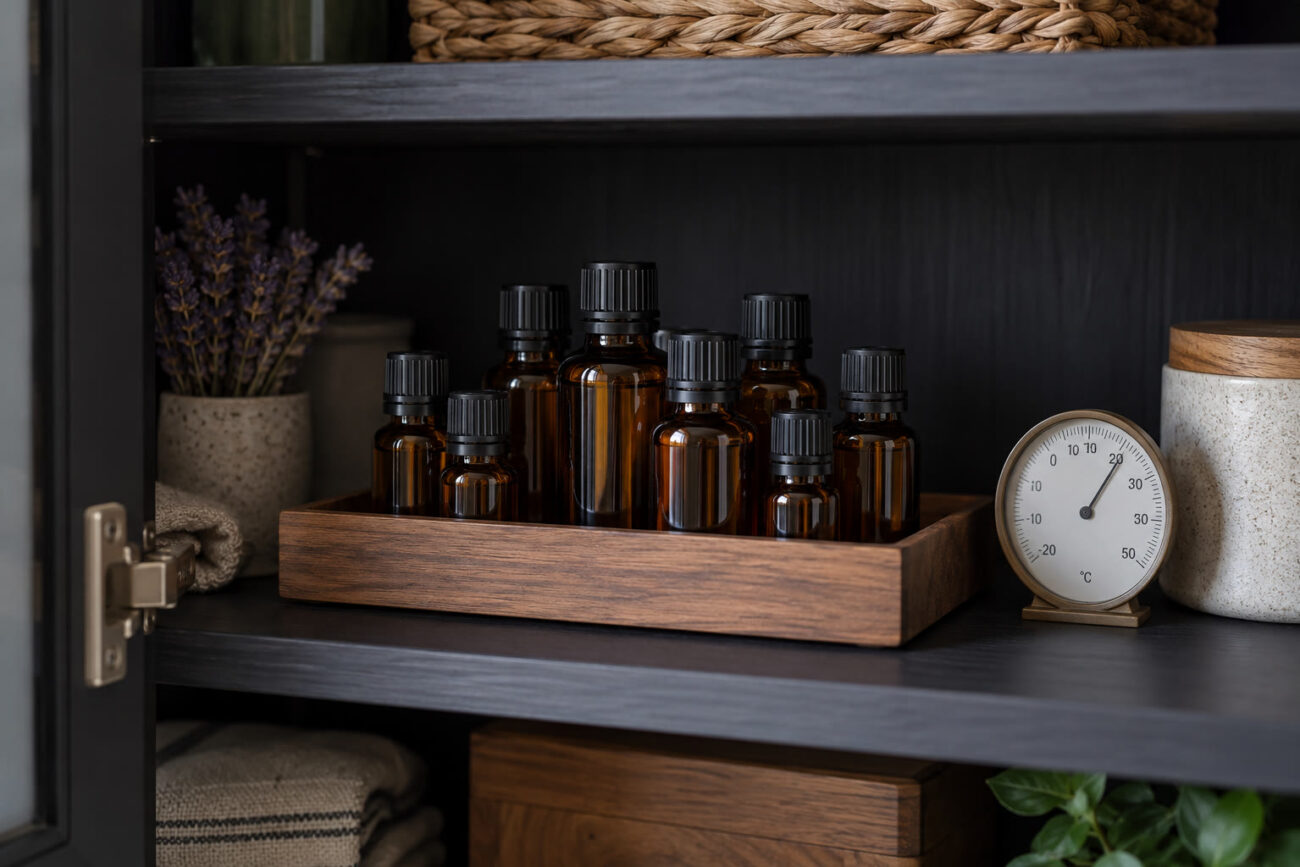
Aromatic oils can change with prolonged exposure to light and heat. Store them in the original dark bottle and away from a sunny windowsill, stovetop, or warm appliance. A cool, dry cabinet is usually more suitable than the bathroom shelf.
Preserve the label and lot information
The botanical name, supplier, batch, and date help you distinguish products with similar scents but different compositions. Never decant an oil into an unmarked water or beverage bottle. If a secondary container is necessary, use a properly labeled compatible bottle.
Check the oil before every use
Notice changes in color, texture, or smell, and discard a product that appears contaminated or rancid. don’t use a questionable oil on skin or in a diffuser. Keep carrier oils in mind too: plant oils can spoil even when the essential oil blended with them remains aromatic.
Store for safety, not collection
A large collection increases the chance of confusion, spills, and children finding an attractive bottle. Keep only quantities you will use, record what you already own, and place everything out of reach. Follow local disposal instructions instead of pouring oils down a drain.
What question deserves a closer look?
Read this article as a short lesson in judgment: the product-use question becomes easier when its purpose, evidence, and limits are separated. The test is whether you can make a more defensible choice about the product-use question afterward and explain why an alternative might also be reasonable for someone else.
The lesson belongs to the Essential Oils & Aromatherapy desk, where the central question is the relationship among botanical identity, concentration, route, duration, and personal tolerance. With the product-use question, start with the purpose of the decision, then distinguish what is directly observable from what you’re inferring. For the product-use question, that discipline matters because a familiar scent or a plant origin doesn’t establish medical effectiveness or universal safety.
How can you tell this approach is working?
You have understood the product-use question when you can name the outcome you want, point to the information that supports the next step, and state what you would do if the evidence or your experience contradicted the expectation. That three-part answer is more reliable than repeating a slogan.
How to reason through the details
Think about the product-use question as a sequence of connected judgments rather than a collection of slogans. For the product-use question, define what the choice must accomplish, inspect the information that bears on that purpose, and then assess whether everyday conditions permit the recommendation. The checkpoints for this particular lesson are keep light and heat out, preserve the label and lot information, check the oil before every use.
The central concept in the product-use question is the relationship among botanical identity, concentration, route, duration, and personal tolerance. For the product-use question, that framing matters because it prevents a single feature from carrying more meaning than it can bear. You may notice the botanical name, the stated route of use, and the response during a brief exposure when considering the product-use question, but each observation supports a different kind of conclusion. Your analytical task with the product-use question is to keep those conclusions proportional to the evidence rather than letting a vivid detail dominate the whole judgment.
In the classroom, work with a labeled essential-oil product and its intended route of exposure for the product-use question. Ask what the comparison is meant to establish before asking which option sounds more appealing.
Before leaving this lesson on the product-use question, return to the decision once more with a calm, practical standard. For this question, notice what you now understand, what remains uncertain, and which small observation would make the next step about the product-use question more defensible. For the product-use question, you can pause without treating uncertainty as failure, and you can return when a better observation becomes available.
How do the details fit together?
A rigorous lesson about the product-use question must keep concentration, route, duration, and population visible at the same time, because a conclusion that’s reasonable for a brief, diluted application can’t be transferred automatically to inhalation in a shared room or to an undiluted cosmetic use. The relevant exposure is produced by the whole situation rather than by the botanical name alone, and this is why instructions and warnings belong to the evidence rather than to an administrative footnote. When those variables are separated, it becomes possible to make a more modest claim about what can be tried safely and what requires qualified advice. That discipline protects both the pleasure of scent and the trust of the person using it.
How can you read the evidence more carefully?
The phrase “essential oil” groups chemically diverse materials, so evidence about lavender can’t be used as automatic evidence for peppermint, citrus, or tea tree simply because all four appear in the aromatherapy aisle. A meaningful interpretation asks which species, plant part, concentration, delivery method, and outcome were studied, then compares those conditions with the product actually at hand. If the comparison fails, the honest response is to treat the claim as suggestive at best and to rely on the product directions rather than an extrapolated therapeutic promise. This standard is demanding, but it gives scent guidance the intellectual honesty expected of university-level material.
Protect the bottle and the people around it
Good storage is mostly a set of ordinary habits: close, label, cool, organize, and keep away from children, pets, and food. Quality and safety both depend on them.
Continue with Why More Essential Oil isn’t Better and Essential Oils in Bath Products: Safer Habits. Browse the Essential Oils & Aromatherapy desk for the wider cluster.
Background source: National Center for Complementary and Integrative Health: Aromatherapy.
Take 10 minutes to read one scent product’s label and note its intended use and one precaution. What will you check before using it?
