You’re looking for clear advice on carrier oils explained for beginners, and a single label or ingredient can make the answer seem simpler than it’s. That can waste money or leave you unsure whether a product fits its intended use. The better approach is to compare the whole formula, directions, and practical tradeoffs. This guide shows you what to look for and how to assess the choice in your own routine.
A carrier changes concentration
Adding an essential oil to a carrier spreads it over the area where it will be used and reduces the concentration at any one point. The correct amount should come from product-specific directions, not from the strongest recipe you can find online. Keep the essential oil and carrier clearly labeled.
Different oils have different textures
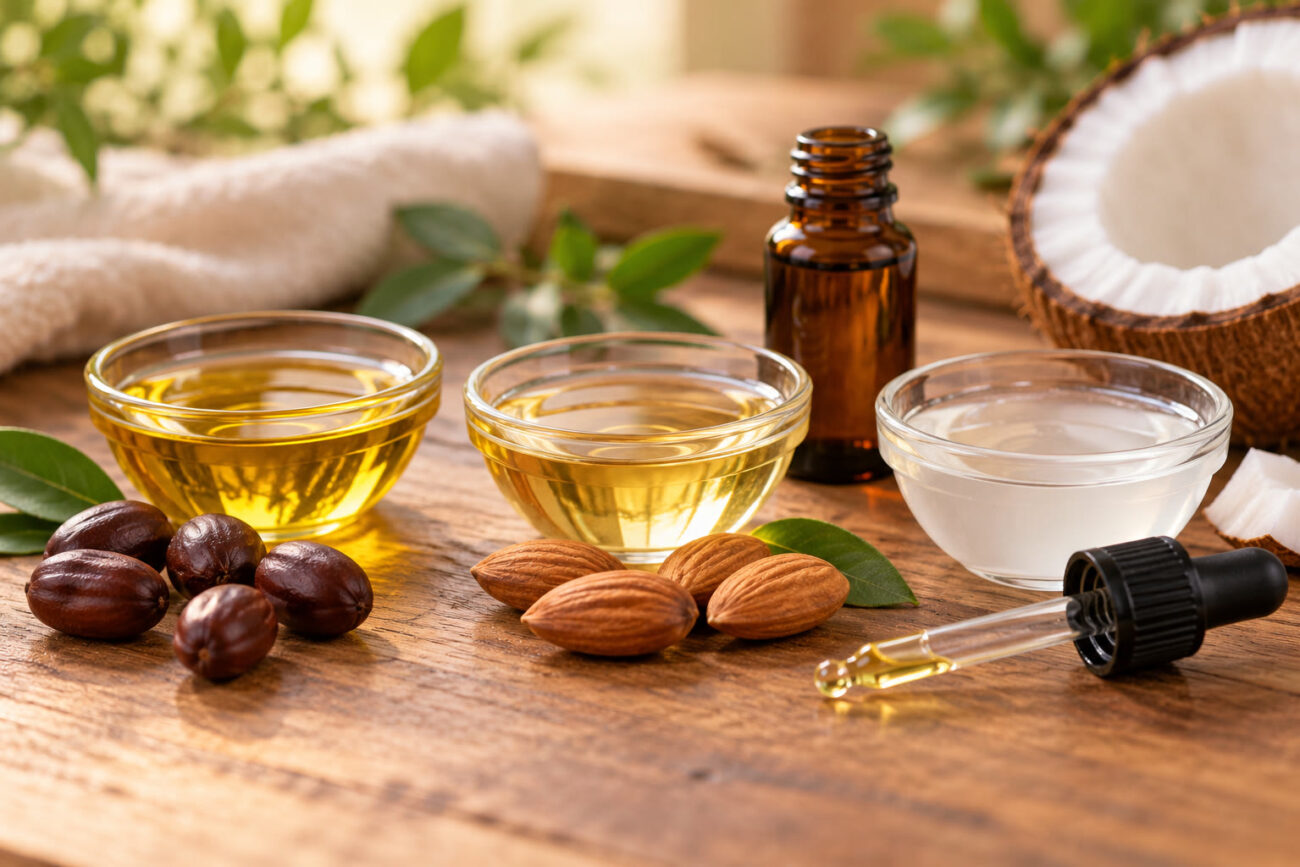
Jojoba, sunflower, almond, and other oils feel and behave differently on skin. A light oil may suit one person while another prefers a richer texture. A carrier used for massage may not be comfortable for the face. Consider allergies and patch test an unfamiliar carrier.
Stability matters over time
Some plant oils oxidize or become rancid more quickly than others. Mixing a large batch can create waste and make it harder to remember what is inside. Prepare small amounts, date the container, and store it away from heat and light.
Carrier doesn’t mean risk-free
Plant oils can cause irritation or allergic reactions in some people. don’t use a carrier oil as a substitute for medical treatment, and seek advice for persistent skin problems or a concerning reaction to a product.
What should you be able to explain?
By the end of this lesson, you should be able to explain this aromatherapy question in your own words and identify which details actually change the decision. For this aromatherapy question, that objective is deliberately practical: it asks for reasoning rather than memorization and leaves room for context to matter.
The lesson belongs to the Essential Oils & Aromatherapy desk, where the central question is the relationship among botanical identity, concentration, route, duration, and personal tolerance. With this aromatherapy question, start with the purpose of the decision, then distinguish what is directly observable from what you’re inferring. For this aromatherapy question, that discipline matters because a familiar scent or a plant origin doesn’t establish medical effectiveness or universal safety.
How can you interpret the choice?
A strong analysis of this aromatherapy question asks what the choice is for, which evidence is genuinely relevant, and whether the resulting recommendation survives ordinary use. The checkpoints for this particular lesson are a carrier changes concentration, different oils have different textures, stability matters over time.
The central concept in this aromatherapy question is the relationship among botanical identity, concentration, route, duration, and personal tolerance. For this aromatherapy question, that framing matters because it prevents a single feature from carrying more meaning than it can bear. You may notice the botanical name, the stated route of use, and the response during a brief exposure when considering this aromatherapy question, but each observation supports a different kind of conclusion. Your analytical task with this aromatherapy question is to keep those conclusions proportional to the evidence rather than letting a vivid detail dominate the whole judgment.
In the classroom, work with a labeled essential-oil product and its intended route of exposure for this aromatherapy question. Ask what the comparison is meant to establish before asking which option sounds more appealing.
What the decision looks like in the real world
Imagine that you’re considering a scented product and need to decide whether it belongs on skin, in a room, or nowhere in the current setting. You don’t need a perfect answer before you begin. You need a sequence that makes the next observation meaningful. Write down what you hope this aromatherapy question will help you do, then name one detail that would support the choice and one detail that would make you hesitate.
In this scenario, the first mistake would be to confuse certainty of tone with certainty of evidence. A familiar botanical name, a pleasant first scent, or a strong cooling sensation can begin a conversation, but the decision becomes teachable only when you explain how that detail relates to the relationship among botanical identity, concentration, route, duration, and personal tolerance. Notice also the constraints: time, cost, storage, other people, and the possibility that the result will be mixed rather than clearly good or bad.
A useful conclusion about this aromatherapy question can therefore be provisional. You might decide that the option is worth a limited trial, that more information is needed, or that the safer choice is to pause. Those are all reasoned outcomes. The purpose of this example isn’t to reward decisiveness at any cost, but to make the quality of your reasoning about this aromatherapy question visible.
How can you read the evidence more carefully?
A rigorous lesson about this aromatherapy question must keep concentration, route, duration, and population visible at the same time, because a conclusion that’s reasonable for a brief, diluted application can’t be transferred automatically to inhalation in a shared room or to an undiluted cosmetic use. The relevant exposure is produced by the whole situation rather than by the botanical name alone, and this is why instructions and warnings belong to the evidence rather than to an administrative footnote. When those variables are separated, it becomes possible to make a more modest claim about what can be tried safely and what requires qualified advice. That discipline protects both the pleasure of scent and the trust of the person using it.
What final check can sharpen your decision?
The phrase “essential oil” groups chemically diverse materials, so evidence about lavender can’t be used as automatic evidence for peppermint, citrus, or tea tree simply because all four appear in the aromatherapy aisle. A meaningful interpretation asks which species, plant part, concentration, delivery method, and outcome were studied, then compares those conditions with the product actually at hand. If the comparison fails, the honest response is to treat the claim as suggestive at best and to rely on the product directions rather than an extrapolated therapeutic promise. This standard is demanding, but it gives scent guidance the intellectual honesty expected of university-level material.
Choose the carrier as carefully as the scent
A carrier is an active part of the mixture’s texture and exposure. Use one that suits the intended area, follow the product directions, and prepare only what you can use confidently.
Two useful follow-up reads are Essential Oils Around Children and Pets and Fragrance Oils vs. Essential Oils. Browse the Essential Oils & Aromatherapy desk for the wider cluster.
Reference: National Center for Complementary and Integrative Health: Aromatherapy.
Take 10 minutes to inspect one soap label and note a detail you want to compare before buying again. Which detail will you check first?
