You’re looking for clear advice on how to patch test a new skin-care product, and mixed guidance can make it hard to tell what fits your skin. That uncertainty can cost you time and money while leaving you unsure what to change. The decision depends on the product details, how you use it, and how your skin responds. This guide shows you what to check, how to make one careful change, and when to seek more help.
Choose a small test area
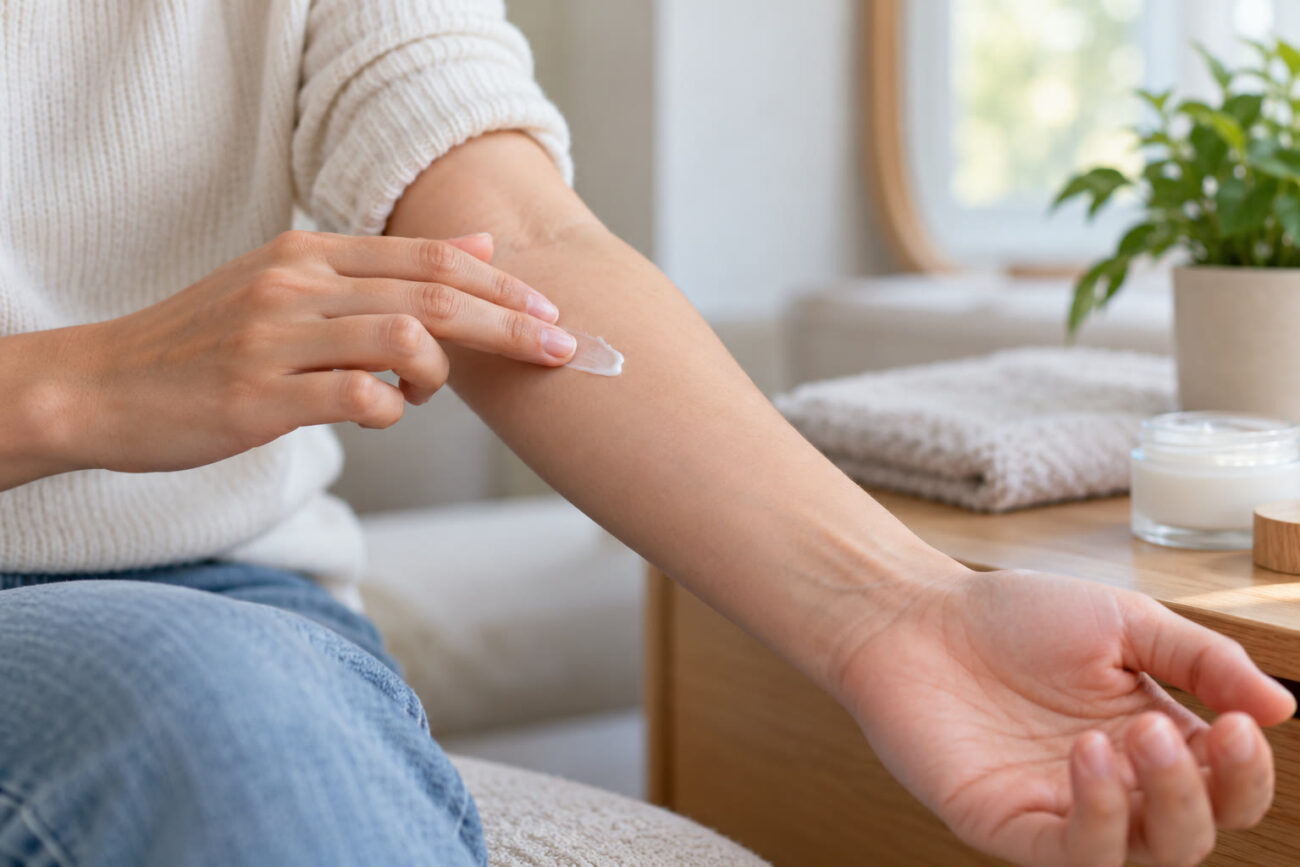
Follow the product’s instructions and choose a convenient area of intact skin, often the inner forearm. Use a small amount and avoid areas that are already irritated. Keep a note of the product, time, and location of the test.
Give a delayed reaction time to appear
Some reactions develop hours later, so observe the area beyond the first few minutes. don’t scrub the product in or leave it on longer than directed. A patch test isn’t a license to use a product that the label says shouldn’t touch skin.
Keep the rest of the routine stable
don’t introduce several new cleansers, moisturizers, or fragrances on the same day. If the test area becomes itchy, red, swollen, or painful, wash the product away and stop using it. Seek medical advice for severe or spreading symptoms.
Use the result to make a decision
A clear test doesn’t guarantee comfort on a larger area or in a different season, especially for products with active ingredients. Recheck the label and use the product as intended. Persistent sensitivities are worth discussing with a dermatologist or pharmacist.
What are you deciding?
Read this article as a short lesson in judgment: the comfort question becomes easier when its purpose, evidence, and limits are separated. The test is whether you can make a more defensible choice about the comfort question afterward and explain why an alternative might also be reasonable for someone else.
The lesson belongs to the Skin Health & Gentle Care desk, where the central question is the relationship among cleansing, barrier support, product contact, and the skin’s observable response. With the comfort question, start with the purpose of the decision, then distinguish what is directly observable from what you’re inferring. For the comfort question, that discipline matters because a single positive or negative experience can’t diagnose a condition or predict how a different formula will behave.
What standard should you apply?
You have understood the comfort question when you can name the outcome you want, point to the information that supports the next step, and state what you would do if the evidence or your experience contradicted the expectation. That three-part answer is more reliable than repeating a slogan.
How can you make a decision you can explain?
To study the comfort question carefully, establish the intended outcome before evaluating the evidence, and reserve the final judgment until practical limitations have been considered. The checkpoints for this particular lesson are choose a small test area, give a delayed reaction time to appear, keep the rest of the routine stable.
The central concept in the comfort question is the relationship among cleansing, barrier support, product contact, and the skin’s observable response. For the comfort question, that framing matters because it prevents a single feature from carrying more meaning than it can bear. You may notice the product directions, the sensation during cleansing, and the skin’s condition several hours later when considering the comfort question, but each observation supports a different kind of conclusion. Your analytical task with the comfort question is to keep those conclusions proportional to the evidence rather than letting a vivid detail dominate the whole judgment.
Picture one cleanser or moisturizer used within an otherwise familiar routine in relation to the comfort question. The useful comparison begins with intended use, because a feature that matters in one setting may be irrelevant in another.
How can you put the principle into practice?
Imagine that you’re introducing a product into a routine that already works most days and want to learn from the change without overwhelming the skin. You don’t need a perfect answer before you begin. You need a sequence that makes the next observation meaningful. Write down what you hope the comfort question will help you do, then name one detail that would support the choice and one detail that would make you hesitate.
In this scenario, the first mistake would be to confuse certainty of tone with certainty of evidence. A gentle-sounding claim, an initially smooth texture, or the absence of immediate stinging can begin a conversation, but the decision becomes teachable only when you explain how that detail relates to the relationship among cleansing, barrier support, product contact, and the skin’s observable response. Notice also the constraints: time, cost, storage, other people, and the possibility that the result will be mixed rather than clearly good or bad.
A useful conclusion about the comfort question can therefore be provisional. You might decide that the option is worth a limited trial, that more information is needed, or that the safer choice is to pause. Those are all reasoned outcomes. The purpose of this example isn’t to reward decisiveness at any cost, but to make the quality of your reasoning about the comfort question visible.
What should you observe next?
For the comfort question, choose one observation that can be recorded without interpretation: what happened, when it happened, and what else changed at the same time. Separating observation from explanation makes the next review more honest and helps you avoid building an entire theory around a single ambiguous moment.
Why the distinction matters
The distinction between cleansing and treatment is especially important when discussing the comfort question. Cleansing removes material from the surface, whereas treatment aims to alter a biological process, and ordinary soap or moisturizer shouldn’t be assumed to perform the latter without appropriate evidence. If the skin shows persistent pain, swelling, cracking, or a spreading rash, the relevant question has moved beyond product selection and into assessment. A caring explanation names that transition clearly, because delaying appropriate care is a more serious failure than choosing a modest cleanser rather than an impressive one.
A methodologically sound comparison of the comfort question also distinguishes short-term sensation from durable comfort. A brief cooling effect, smooth texture, or absence of immediate stinging can be pleasant, yet those first impressions aren’t interchangeable with how the skin behaves hours later or after repeated use. Recording the timing of observations helps prevent a vivid early signal from eclipsing delayed irritation or gradual improvement. The resulting account is more specific and more useful than either a testimonial or a marketing claim, because it describes what happened and identifies the limits of what can be concluded.
When the question concerns the comfort question, the word “gentle” should function as a testable aspiration rather than a guarantee. Gentleness depends on what is being washed, how often the product is used, how long it remains on the skin, and which other exposures are present in the routine. This is why the most responsible advice often begins with reducing heat, friction, frequency, or the number of new products before introducing another formula. An analytical approach makes room for that simpler explanation and avoids treating every uncomfortable result as a reason to purchase a more specialized solution.
Test small and change one thing
A patch test is a practical first step, not proof of universal safety. Use it with clear product information and an honest review of the response.
Continue with Fragrance-Free vs. Unscented: Why the Difference Matters and Moisturizer Basics for Everyday Skin Comfort. Browse the Skin Health & Gentle Care desk for the wider cluster.
Background source: American Academy of Dermatology: Face washing and skin care.
In the next 10 minutes, write down one skin-care change you can make while keeping the rest of your routine steady. Which detail will you watch first?
