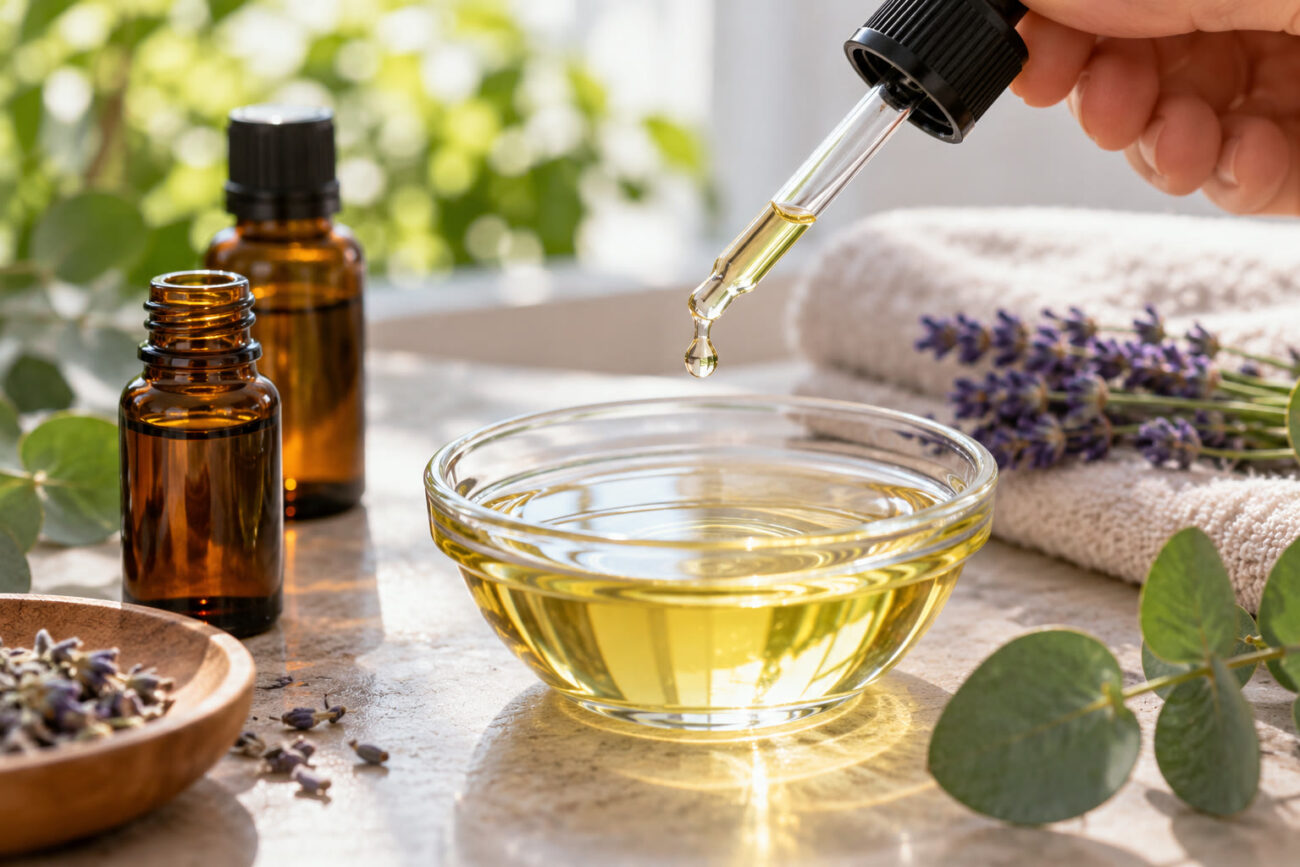
You’re looking for clear advice on how to dilute essential oils for topical use, and strong claims can make a simple choice feel complicated. That confusion can lead to unnecessary exposure, wasted money, or expectations a product can’t meet. The useful question is how the scent is used, who may be affected, and what the evidence can support. This guide shows you how to check those details and choose a cautious next step.
Start with the product directions
Different oils and finished products have different recommended uses and limits. A dilution mentioned for an adult massage oil shouldn’t be assumed safe for a child, a larger skin area, or a damaged skin barrier. don’t increase the amount because the scent is faint.
Use an appropriate carrier
A carrier can be a plant oil or another product designed to disperse essential oil safely. It should be compatible with the essential oil and acceptable for your skin. Keep the bottle clean, measure deliberately, and avoid dipping contaminated fingers back into a shared container.
Write down what the mixture contains
A small label with the date, oils, carrier, and intended use prevents confusion later. Mixtures don’t become risk-free simply because they’re homemade. Store them away from heat and light, and discard anything that smells rancid or contaminated.
Treat irritation as a stop signal
If burning, redness, swelling, or another unusual response occurs, stop using the mixture and wash the area with mild soap and water. Persistent or severe symptoms need qualified medical advice. Seek urgent help for breathing difficulty, facial swelling, or other signs of a serious reaction.
What are you deciding?
A useful understanding of this aromatherapy question should survive contact with a real setting, a busy day, or a situation that doesn’t match the example. For this aromatherapy question, that objective is deliberately practical: it asks for reasoning rather than memorization and leaves room for context to matter.
The lesson belongs to the Essential Oils & Aromatherapy desk, where the central question is the relationship among botanical identity, concentration, route, duration, and personal tolerance. With this aromatherapy question, start with the purpose of the decision, then distinguish what is directly observable from what you’re inferring. For this aromatherapy question, that discipline matters because a familiar scent or a plant origin doesn’t establish medical effectiveness or universal safety.
How can you tell this approach is working?
You have understood this aromatherapy question when you can name the outcome you want, point to the information that supports the next step, and state what you would do if the evidence or your experience contradicted the expectation. That three-part answer is more reliable than repeating a slogan.
How can you interpret the choice?
A strong analysis of this aromatherapy question asks what the choice is for, which evidence is genuinely relevant, and whether the resulting recommendation survives ordinary use. The checkpoints for this particular lesson are start with the product directions, use an appropriate carrier, write down what the mixture contains.
The central concept in this aromatherapy question is the relationship among botanical identity, concentration, route, duration, and personal tolerance. For this aromatherapy question, that framing matters because it prevents a single feature from carrying more meaning than it can bear. You may notice the botanical name, the stated route of use, and the response during a brief exposure when considering this aromatherapy question, but each observation supports a different kind of conclusion. Your analytical task with this aromatherapy question is to keep those conclusions proportional to the evidence rather than letting a vivid detail dominate the whole judgment.
In the classroom, work with a labeled essential-oil product and its intended route of exposure for this aromatherapy question. Ask what the comparison is meant to establish before asking which option sounds more appealing.
What the decision looks like in the real world
Imagine that you’re considering a scented product and need to decide whether it belongs on skin, in a room, or nowhere in the current setting. You don’t need a perfect answer before you begin. You need a sequence that makes the next observation meaningful. Write down what you hope this aromatherapy question will help you do, then name one detail that would support the choice and one detail that would make you hesitate.
In this scenario, the first mistake would be to confuse certainty of tone with certainty of evidence. A familiar botanical name, a pleasant first scent, or a strong cooling sensation can begin a conversation, but the decision becomes teachable only when you explain how that detail relates to the relationship among botanical identity, concentration, route, duration, and personal tolerance. Notice also the constraints: time, cost, storage, other people, and the possibility that the result will be mixed rather than clearly good or bad.
A useful conclusion about this aromatherapy question can therefore be provisional. You might decide that the option is worth a limited trial, that more information is needed, or that the safer choice is to pause. Those are all reasoned outcomes. The purpose of this example isn’t to reward decisiveness at any cost, but to make the quality of your reasoning about this aromatherapy question visible.
How can you read the evidence more carefully?
A rigorous lesson about this aromatherapy question must keep concentration, route, duration, and population visible at the same time, because a conclusion that’s reasonable for a brief, diluted application can’t be transferred automatically to inhalation in a shared room or to an undiluted cosmetic use. The relevant exposure is produced by the whole situation rather than by the botanical name alone, and this is why instructions and warnings belong to the evidence rather than to an administrative footnote. When those variables are separated, it becomes possible to make a more modest claim about what can be tried safely and what requires qualified advice. That discipline protects both the pleasure of scent and the trust of the person using it.
Why the distinction matters
The phrase “essential oil” groups chemically diverse materials, so evidence about lavender can’t be used as automatic evidence for peppermint, citrus, or tea tree simply because all four appear in the aromatherapy aisle. A meaningful interpretation asks which species, plant part, concentration, delivery method, and outcome were studied, then compares those conditions with the product actually at hand. If the comparison fails, the honest response is to treat the claim as suggestive at best and to rely on the product directions rather than an extrapolated therapeutic promise. This standard is demanding, but it gives scent guidance the intellectual honesty expected of university-level material.
Measure, label, and keep the exposure modest
Good dilution is thoughtful preparation rather than a stronger version of an essential oil. Use the product’s directions, a sensible carrier, and a clear record of what you made.
Two useful follow-up reads are Essential Oil Claims: How to Separate Hype from Evidence and Lavender Oil: What People Use It For. Browse the Essential Oils & Aromatherapy desk for the wider cluster.
Reference: National Center for Complementary and Integrative Health: Aromatherapy.
Take 10 minutes to read one scent product’s label and note its intended use and one precaution. What will you check before using it?
