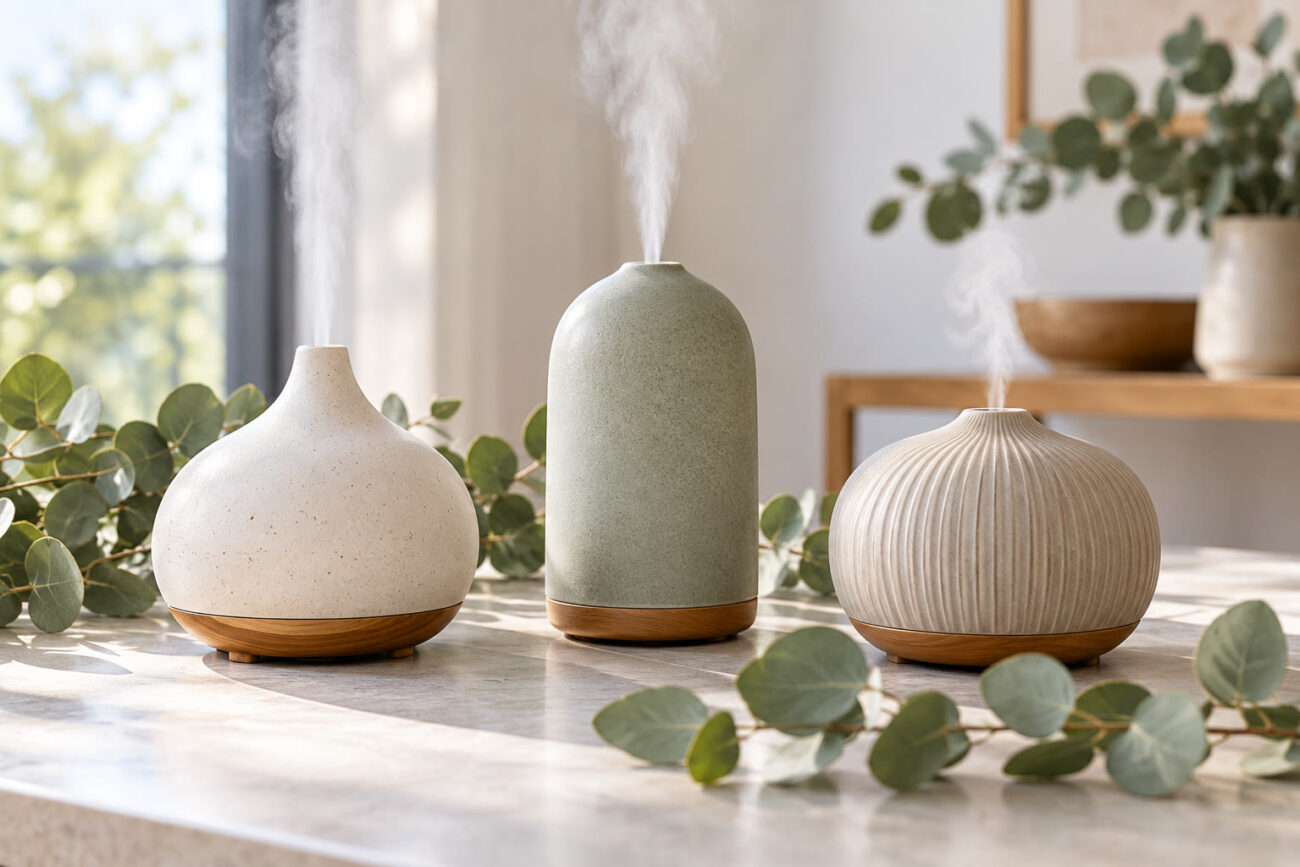
You’re looking for clear advice on how to choose an essential oil diffuser, and strong claims can make a simple choice feel complicated. That confusion can lead to unnecessary exposure, wasted money, or expectations a product can’t meet. The useful question is how the scent is used, who may be affected, and what the evidence can support. This guide shows you how to check those details and choose a cautious next step.
Match the device to the room
A large open-plan space may need very different use from a small bedroom. More dispersal isn’t necessarily better, and a diffuser can spread fragrance into shared air. Begin with short sessions and ventilation so others can choose their exposure.
Look for practical controls
Automatic shutoff, adjustable output, and easy access to the reservoir make a device safer and less wasteful. Avoid running it continuously while you sleep or leave the house. A simple timer can be more useful than an array of colored lights.
Cleaning is part of performance
Residue can collect in the reservoir and change how the device performs. Follow the manufacturer’s cleaning instructions and use the device only with the specified liquids. don’t be tempted to combine several oils just to create a stronger atmosphere.
Not everyone should share the scent
Homes can include people with asthma, fragrance sensitivity, young children, or pets. Honor requests to turn off the device, and don’t diffuse near pets without checking reliable species-specific safety guidance. A pleasant room for one person can be an uncomfortable or unsafe room for someone else.
What should you be able to explain?
The aim of this guide isn’t to hand you a verdict about the product-use question, but to make the reasoning behind a sound choice visible. The test is whether you can make a more defensible choice about the product-use question afterward and explain why an alternative might also be reasonable for someone else.
The lesson belongs to the Essential Oils & Aromatherapy desk, where the central question is the relationship among botanical identity, concentration, route, duration, and personal tolerance. With the product-use question, start with the purpose of the decision, then distinguish what is directly observable from what you’re inferring. For the product-use question, that discipline matters because a familiar scent or a plant origin doesn’t establish medical effectiveness or universal safety.
How can you tell this approach is working?
You have understood the product-use question when you can name the outcome you want, point to the information that supports the next step, and state what you would do if the evidence or your experience contradicted the expectation. That three-part answer is more reliable than repeating a slogan.
How to reason through the details
Think about the product-use question as a sequence of connected judgments rather than a collection of slogans. For the product-use question, define what the choice must accomplish, inspect the information that bears on that purpose, and then assess whether everyday conditions permit the recommendation. The checkpoints for this particular lesson are match the device to the room, look for practical controls, cleaning is part of performance.
The central concept in the product-use question is the relationship among botanical identity, concentration, route, duration, and personal tolerance. For the product-use question, that framing matters because it prevents a single feature from carrying more meaning than it can bear. You may notice the botanical name, the stated route of use, and the response during a brief exposure when considering the product-use question, but each observation supports a different kind of conclusion. Your analytical task with the product-use question is to keep those conclusions proportional to the evidence rather than letting a vivid detail dominate the whole judgment.
In the classroom, work with a labeled essential-oil product and its intended route of exposure for the product-use question. Ask what the comparison is meant to establish before asking which option sounds more appealing.
How can you apply this reasoning?
Imagine that you’re considering a scented product and need to decide whether it belongs on skin, in a room, or nowhere in the current setting. You don’t need a perfect answer before you begin. You need a sequence that makes the next observation meaningful. Write down what you hope the product-use question will help you do, then name one detail that would support the choice and one detail that would make you hesitate.
In this scenario, the first mistake would be to confuse certainty of tone with certainty of evidence. A familiar botanical name, a pleasant first scent, or a strong cooling sensation can begin a conversation, but the decision becomes teachable only when you explain how that detail relates to the relationship among botanical identity, concentration, route, duration, and personal tolerance. Notice also the constraints: time, cost, storage, other people, and the possibility that the result will be mixed rather than clearly good or bad.
A useful conclusion about the product-use question can therefore be provisional. You might decide that the option is worth a limited trial, that more information is needed, or that the safer choice is to pause. Those are all reasoned outcomes. The purpose of this example isn’t to reward decisiveness at any cost, but to make the quality of your reasoning about the product-use question visible.
How do the details fit together?
A rigorous lesson about the product-use question must keep concentration, route, duration, and population visible at the same time, because a conclusion that’s reasonable for a brief, diluted application can’t be transferred automatically to inhalation in a shared room or to an undiluted cosmetic use. The relevant exposure is produced by the whole situation rather than by the botanical name alone, and this is why instructions and warnings belong to the evidence rather than to an administrative footnote. When those variables are separated, it becomes possible to make a more modest claim about what can be tried safely and what requires qualified advice. That discipline protects both the pleasure of scent and the trust of the person using it.
Choose control over coverage
The best diffuser is one you run briefly, clean easily, and switch off when anyone in the home needs a break from fragrance. Short, intentional use is more sensible than constant output.
Related practical guidance includes Essential Oil Allergies: Signs to Watch For and Why More Essential Oil isn’t Better. Browse the Essential Oils & Aromatherapy desk for the wider cluster.
Storage is another part of using essential oils thoughtfully. See How to Store Essential Oils Properly.
Reference: National Center for Complementary and Integrative Health: Aromatherapy.
Take 10 minutes to read one scent product’s label and note its intended use and one precaution. What will you check before using it?
